Loading…
Loading

 Douglas LivaUT-4717AJohn HillUT-383707AJesse GardnerUT-380938ARobert ValenciaUT-391234A
Loading
Forest Health & Species Care
September 4, 2026
The species you are most likely to actually have on a Wasatch Back lot — aspen, blue spruce, Douglas-fir, lodgepole pine, Gambel oak, juniper and more, with ID cues, risk profiles, and management notes for each.
Most Park City property owners inherit their trees. You buy a wooded lot, the trees are just there, and unless something goes wrong you probably don’t give any single species much thought.
That’s an expensive habit on the Wasatch Back. The management approach for a stand of lodgepole pine is nothing like the approach for a Gambel oak thicket. A blue spruce next to the house is a landscape asset; a Rocky Mountain juniper in the same spot is a wildfire liability that most defensible-space plans will require you to remove. Sudden Aspen Decline is decimating one species and not the four other ones next to it. Bark-beetle risk is concentrated in a very specific subset of your conifers.
This is a Park City homeowner’s field guide to the tree species you’re most likely to actually have on your property — how to identify them, how they behave through the seasons, what they’re vulnerable to, and what an arborist will typically recommend for each. It’s written for the Wasatch Back specifically: Park City, Deer Valley, Heber City, Midway, Kamas, Oakley, and the surrounding subdivisions.
The single most useful concept for tree identification in this landscape isn’t bark or needle length — it’s elevation. The Wasatch stacks its trees in bands:
When you’re trying to figure out what’s on your lot, start there. A sunny south-facing yard in Heber at 5,500 ft will have essentially no tree species in common with a north-facing lot in Empire Pass at 8,700 ft, even though they’re fifteen miles apart.
How to identify:Smooth chalk-white or greenish bark that photographs the way people expect it to. Round leaves with a flattened petiole that lets them tremble in the slightest breeze — the “quaking” in the name. Yellow to orange fall color. Almost always in clonal groves rather than single trees.
Where in Park City:Almost everywhere between 6,500 and 9,500 ft. Deer Valley, Empire Pass, upper Pinebrook, the canyon shoulders around Kamas and Oakley — all classic aspen country.
What’s at risk:Sudden Aspen Decline (SAD) is the story here. Utah’s aspen forests have lost significant acreage since the early 2000s to a syndrome of drought stress, cavitation, poplar borers, and Cytospora canker. Our Sudden Aspen Decline field guide goes into what to look for and which interventions still work on a struggling clone.
Management notes: Aspen respond well to selective thinning, protection of the root system from mechanical damage, and understory management. They do notrespond well to being surrounded by lawn irrigation, sod, or heavy foot traffic. If you’re landscaping around an aspen grove, respect the drip line and keep the root zone loose and mulched.
How to identify: The state tree of Utah, and one of the easiest to identify. Silver-blue needles (the color is real, not a cultivar exclusive) that are stiff, four-sided, and sharp enough to poke through gloves. Classic Christmas-tree pyramidal shape, especially on younger specimens. Cones are papery, hang downward, and shed intact.
Where in Park City:Widely planted as a landscape tree in every subdivision on the Wasatch Back. In wild stands, typically along drainages and moist swales between 6,500 and 9,500 ft. If it’s planted in a row along a driveway or a property line, it’s almost certainly a blue spruce.
What’s at risk:Blue spruce is susceptible to Cytospora canker (branch dieback progressing from the bottom up), needle cast diseases, and spruce budworm. Beetle risk is moderate — less than pure Engelmann stands, but still present, especially where blue spruce is stressed by lawn irrigation on shallow soils.
Management notes:Once the lower branches start dying and browning out, you’re in Cytospora country and the prognosis for that specific tree is poor. Blue spruce also struggles when planted too close to a house — they want their space, and shaded, damp, or root-restricted specimens tend to fail early.
How to identify: The high-elevation cousin of blue spruce. Similar four-sided needles but softer, less rigid, and greener in color. Narrow spire-like crown at maturity. Bark is thin and scaly.
Where in Park City:High elevations, generally above 8,000 ft — upper Deer Valley, Empire Pass, the resort terrain, and backcountry lots.
What’s at risk: The spruce beetle (Dendroctonus rufipennis) is the story. Engelmann spruce stands across the Intermountain West have taken enormous mortality losses to spruce beetle outbreaks since the 2000s, and Utah is no exception. Our bark beetle field guide covers what an active spruce beetle infestation looks like and how to interrupt an outbreak on your lot.
Management notes:Same-age, high-density stands are the highest risk. Age-class diversification, selective thinning, and prompt removal of dead or symptomatic trees are the core interventions. On a high-elevation Park City lot with a mixed spruce–fir stand, this is the species most likely to trigger an expensive removal after beetle-kill.
How to identify:The other high-elevation conifer, and easy to confuse with spruce if you don’t look closely. Needles are flat(spruce are square) and softer — you can roll a spruce needle between your fingers, but a fir needle stays flat. Cones stand upright on the branch and disintegrate on the tree rather than falling intact.
Where in Park City: Mixed with Engelmann spruce above 8,000 ft, often in wetter pockets.
What’s at risk:Balsam woolly adelgid, western balsam bark beetle, and root rot in over-mature stands. Fir is often the species that stays green while surrounding spruce die back — but the reverse can also happen where specific fir-targeting pests are present.
Management notes:Structural pruning matters here. Subalpine fir gets tall and narrow with heavy snow-load risk on the lower canopy, and it’s a candidate species for a homeowner’s professional pruning program to keep the canopy shape safe over roofs and driveways.
How to identify:One of the most distinctive cones in North America — papery scales with three-pointed “mouse tail” bracts sticking out between them. Needles are flat, soft, and grow all the way around the twig (not two-ranked like true firs). Bark on mature trees is deeply furrowed and corky.
Where in Park City:Mid-elevation, especially on cooler north-facing slopes. Common through Silver Creek, Promontory, Old Ranch Road, and the middle-elevation canyons. Despite the name, it’s not a true fir.
What’s at risk:Douglas-fir tussock moth (episodic defoliation), Douglas-fir beetle in older or stressed trees, and western spruce budworm (which despite the name attacks Douglas-fir more heavily than actual spruce). Overall, it’s one of the more resilient species on the Wasatch, especially younger specimens on good sites.
Management notes:Douglas-fir is often the best candidate for retention when you’re thinning a mixed conifer stand for fire mitigation, because it’s taller, deeper-rooted, and more fire-tolerant than the surrounding lodgepole and spruce.
How to identify:Two-needle pine with needles 3–7 cm long, growing in tight bundles. Narrow straight trunk that gave it the name (indigenous peoples used it for lodge poles). Small egg-shaped serotinous cones that often stay closed on the branches for years. Thin, plated bark.
Where in Park City:High-elevation stands, especially in old burn scars. Common in the ski neighborhoods — Empire Pass, upper Deer Valley, the resort terrain.
What’s at risk:Mountain pine beetle. This is the species most infamously affected by beetle outbreaks across the West, and Utah’s lodgepole stands are no exception. Same-age, over-dense stands (the natural regeneration pattern after fire) are especially vulnerable. Look for pitch tubes on the bark, fine boring dust at the base, and needles fading to yellow-red then gray.
Management notes:Lodgepole thinning is one of the highest-value services we do on high-elevation Park City lots. Getting stand density down interrupts beetle outbreaks before they take the whole stand, and thinned lodgepole responds well — the survivors put on structure quickly. See our fire mitigation guide for the zone-by-zone thinning approach.
How to identify:Three-needle pine with long (12–25 cm) needles in bundles of three. Mature bark is a distinctive orange-brown puzzle-piece pattern, sometimes described as smelling like vanilla or butterscotch on warm days. Cones are larger than lodgepole — egg-shaped, 8–15 cm long, with prickle-tipped scales.
Where in Park City:Uncommon in the immediate Park City area — you see them more often at lower, warmer elevations. If you have one in the yard, it was probably planted.
What’s at risk:Western pine beetle, mountain pine beetle in stressed trees, and lightning strikes (they’re often the tallest thing on their sites).
Management notes:Mature ponderosa is one of the most fire-adapted trees in North America — thick bark, high crown, self-pruning lower branches. If you have one on a defensible-space plan, it’s usually a retention keeper.
How to identify:The scrub oak that dominates south-facing slopes across the Wasatch Back. Grows in dense thickets (clones connected by root systems), rarely gets tall — usually 6–25 ft. Deeply lobed leaves that go red or russet-brown in fall. Small acorns.
Where in Park City: Almost everywhere below 7,500 ft, on any south or west-facing slope. Especially heavy cover on the sunny sides of the Silver Creek and Old Ranch Road subdivisions.
What’s at risk: Gambel oak is remarkably resilient as a species, but individual stands are a fire mitigation priority because the dense thickets and dead-branch accumulation make them a classic ladder-fuel and continuous-fuel problem. Our hazardous fuel guide walks through the specific work required in oak thickets.
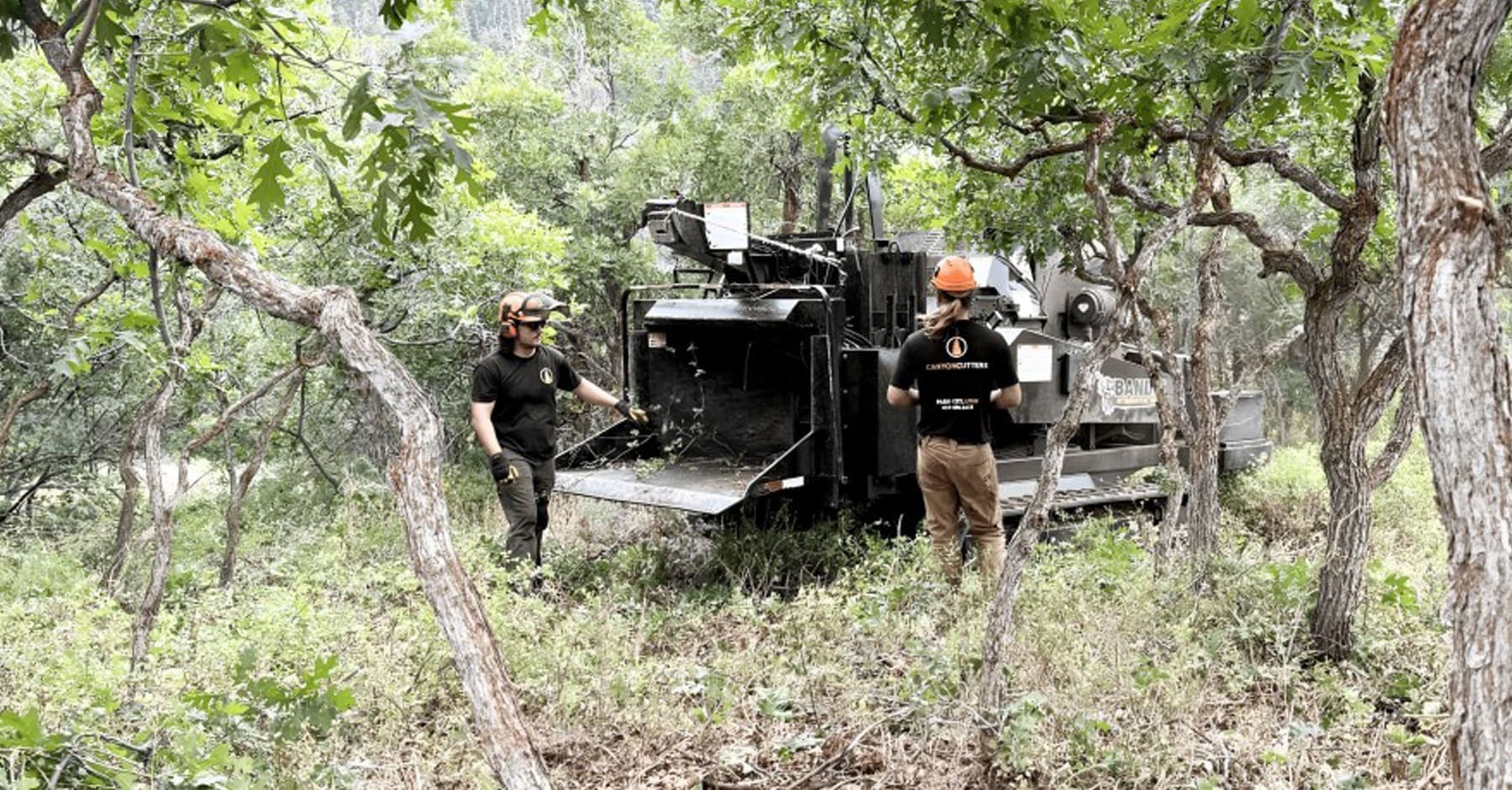
Management notes:Gambel oak sprouts vigorously from the root system after cutting, so a one-time removal doesn’t work — you either commit to periodic mechanical management or accept that it’s coming back. On wildland-interface lots, a professional mulching or chipping pass through oak thickets is a common recurring service.
How to identify: Scale-like blue-green foliage (not needle-like), often growing tight to the trunk. Small blue-gray waxy berries (technically cones). Small tree or large shrub, often twisted and scrappy on exposed sites. Shreddy bark.
Where in Park City: Dry south-facing lower elevations, and widely planted as a landscape shrub or hedge in residential yards.
What’s at risk: Juniper itself is quite drought-tolerant. The propertyaround it is what’s at risk — juniper is one of the most flammable landscape plants in North America. The oil content in the foliage is extremely high, and juniper burns hot, fast, and with intense radiant heat.
Management notes: On any Park City property with wildfire exposure, junipers within 30 feet of the house are typically a Zone 1 removal item on the defensible-space plan. This is one of the most common mitigation recommendations we make. Beautiful plant in the right place, wrong plant next to a wood-frame structure.
How to identify: The big deciduous trees along creek beds and irrigation ditches. Narrowleaf cottonwood (Populus angustifolia) has willow-like narrow leaves; Fremont cottonwood (Populus fremontii) has broad triangular leaves and dominates lower valley riparian corridors.
Where in Park City: Along the Provo River, along the Weber, along irrigation ditches, and wherever a creek runs through a subdivision.
What’s at risk:Cottonwoods are short-lived (100–150 years) and prone to sudden major limb drops, especially in windstorms. Old cottonwoods near driveways or structures are one of the highest-risk species to leave standing on a Park City property.
Management notes: Structural pruning is important. A well-maintained cottonwood is a fine yard tree; a neglected 60-year-old one over the driveway is a phone call to the insurance adjuster waiting to happen. See our companion piece on how insurance handles tree damage if that’s the situation you’re looking at.
How to identify:The species that gives the Wasatch its famous red fall color. Small to medium tree, 20–35 ft, often multi-stemmed. Maple-shaped leaves with rounded lobes (unlike the pointed lobes of sugar maple). Brilliant orange to scarlet fall color, sometimes yellow on shaded sites.
Where in Park City: Mid-elevation canyons and moist draws. Especially heavy in the canyons above Salt Lake (Millcreek, Big Cottonwood) but also present in Wasatch Back canyons.
What’s at risk: Generally low-risk. Some anthracnose in wet springs, some canker in stressed trees.
Management notes:A high-value landscape species that’s often worth working around during land-clearing projects. Flag mature bigtooth maples for retention when you’re planning land management work.
The fastest field key for the species above, given a mystery tree:
Getting fluent with species on your own property changes what you notice from year to year. You start seeing when the aspen catkins come out, when the pines flush, when the oak leaves turn. You also start seeing the failure signs earlier — a lodgepole that fades to yellow-red is a beetle-mortality call weeks earlier than you’d spot the same problem in an unfamiliar stand.
The next step for most owners is a documented species inventory: an ISA-certified arborist walks the property, IDs every canopy tree over roughly 6-inch DBH, and hands you a written map with species, condition, and priority notes. On a mixed 1–5 acre Wasatch lot, this typically takes an hour or two and becomes the planning document for every subsequent decision — from insurance risk to defensible space to which trees you want to light up in the fall color photos.
For further reading on Utah tree species, the USU Forestry Extension publishes detailed identification guides and species-selection tools built for the Utah climate zones.
Canyon Cutters walks Park City properties every week during growing season, and species inventory is a routine part of any first-visit consultation. Whether you’ve got a young landscape to plan around or a mature mixed stand you want to understand, reach out through our contact page or call (201) 960-8275. The first visit is free, always in writing, and the species map alone is often the highest-value 30 minutes a new mountain property owner will spend.
Tags
Free Consultation
Tell us about your land and we'll set up a free on-site visit and walk it with you.
ISA Certified Arborist · Licensed & insured · Free, no-obligation estimates