Loading…
Loading

 Douglas LivaUT-4717AJohn HillUT-383707AJesse GardnerUT-380938ARobert ValenciaUT-391234A
Loading
Fire Mitigation
November 12, 2026
Why scrub oak resprouts after every cut, which timing and treatments wear it down, and how to thin it for fire without stripping the slope.
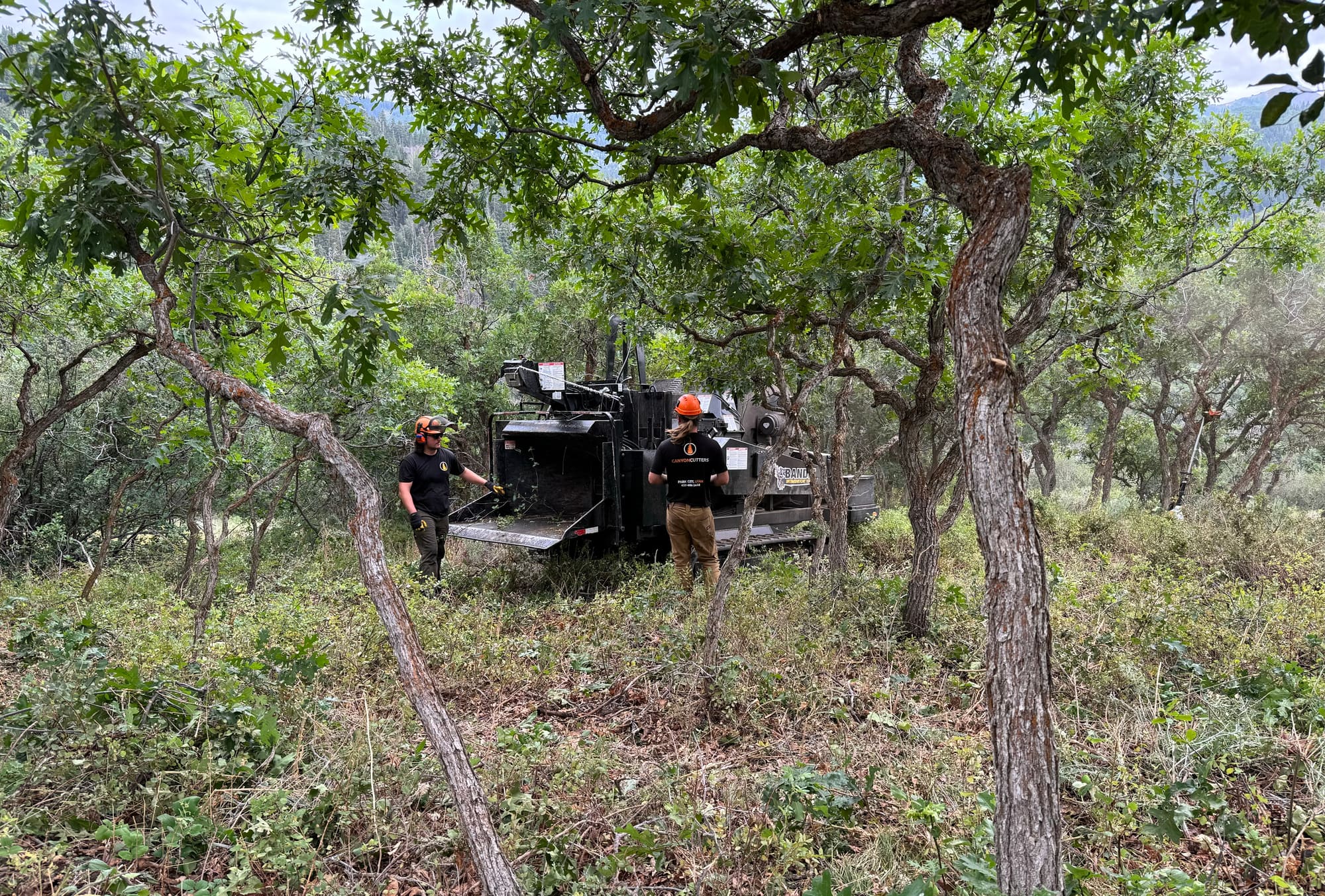
You usually cannot get rid of scrub oak by cutting it once. Gambel oak grows as a clone joined by underground lignotubers, and it resprouts within weeks of being cut or burned. Control works by cutting repeatedly at the right time of year, treating fresh stumps, or browsing it with goats, so the roots run out of stored energy. On most Wasatch Back lots the realistic goal is thinning it into separated clumps, not eradication.
According to the U.S. Forest Service’s Fire Effects Information System, northern Gambel oak clones carry 100 to 1,000 stems each, and “lignotubers provide the primary source for regeneration after top-kill.” USU Extension notes that “often all plants in an area are interconnected.” Cut one stem and the shared root system pushes up several more.
Stands also creep. Utah thickets expand about 4 inches a year on average. After one northern Utah fire, sprouts appeared within 10 days and grew 16 to 18 inches in the first year. Fire usually makes stands denser, not thinner.
Green oak in early summer does not burn easily. The risk comes in late summer and fall. USU says fire danger is highest “during late summer or fall when the leaves are dry,” and the Forest Service notes that August foliage holds less than half the moisture of May foliage. Dead leaves cling to the branches through fall.
The bigger danger is continuity. Dense oak under conifers works as a ladder, carrying a ground fire into tree crowns. That is why oak is central to the hazardous fuel picture here, and why lot assessments under Utah’s HB 48 look at it.
| Method | How it works | Best timing | Trade-off |
|---|---|---|---|
| Repeated cutting or mowing | Top-kill drains root reserves when sprouts regrow | Summer; recut sprouts every year | Takes several years; one cut alone increases sprouting |
| Cut-stump herbicide | Triclopyr on the fresh cut stops resprouting | Within one hour of cutting | Must follow the label; keep away from desirable plants |
| Goats | Browsing strips leaves and sprouts | Late June and August, two years running | Needs fencing and a grazier |
| Thinning into clumps | Breaks up fuel continuity while keeping the shrub | Late fall or early spring for landscape pruning | Ongoing sprout maintenance |
Timing matters more than tools.The Forest Service’s fire effects review notes that fall treatment gives “the least control,” because root reserves peak in fall. Cutting in summer forces regrowth that cannot rebuild those reserves before winter, which stalls recovery for 9 to 10 months. In studies it reviewed, two summer burns in a row reduced the oak.
Cut-stump treatment. Colorado State Extension says “prolific sprouting follows cutting unless herbicides are applied to the cut stumps,” and that triclopyr (sold as Garlon) has been effective at killing oak brush. It has to go on “before the wood dries, usually within one hour of cutting.” Always follow the product label.
Goats. One northern Utah study cited by the Forest Service saw a 78% oak reduction after two years of goat browsing at 5 to 10 goats per acre.
Even so, the Forest Service notes that “total eradication is rare.” Plan on follow-up visits.
For most homeowners, removing every stem is the wrong goal. Oak holds steep soils, and USU calls it “a great choice for watershed protection.” Clear-cutting a slope trades a fire problem for an erosion problem, and the sprouts come back anyway.
The better approach is breaking oak into separated clumps:
Our species field guide covers how oak fits with the aspen and conifers around it.
Oak brush is bulky, so chipping on site is usually far cheaper than hauling. Our tree chipping guide covers when to leave chips and when to haul them. Keep chips out of the first five feet around structures. Inside Park City Fire District boundaries, the district runs a free summer chipping program for residents; check pcfd.org for next year’s registration.
Yes. It resprouts from shared roots, often within weeks. Repeated summer cutting, stump treatment or goats are needed to wear it down.
For control, summer, when root reserves are lowest. Fall cutting gives the least control.
Mostly in late summer and fall, when foliage dries and dead leaves stay on. Dense oak under trees also acts as ladder fuel.
Usually not. Thinning it into spaced clumps lowers fire risk while keeping the roots that hold the slope.
We map which oak to remove, which to thin, and how to keep sprouts down over the next few seasons. Contact us or call (201) 960-8275, or read about our fire mitigation and land management work.
Tags
Free Consultation
Tell us about your land and we'll set up a free on-site visit and walk it with you.
ISA Certified Arborist · Licensed & insured · Free, no-obligation estimates